

Radix | Q&A with Anne Breymann

With a career spanning illustration, animation and puppetmaking, Berlin-based artist and visual storyteller Anne Breymann has recently been making waves – and winning awards – with her latest independently-produced stop-motion short film Radix. Something of a spiritual successor to 2016’s Nocturne, in which a group of mystical woodland entities congregate in a woodland clearing to gamble, Radix adopts a similar, yet evolved, stop-motion style and aesthetic, simultaneously haunting and beautiful in its depiction of two creatures who meet on a tree branch and their metaphysical interaction with one another.
During its ongoing festival run, which has included stops at Annecy, Encounters, Pictoplasma, Animator Festival, Etiuda & Anima, Imaginaria and our own Skwigly Screening at Manchester Animation Festival, the film recently qualified for Academy Award consideration with its Jury Award win at New Hampshire Film Festival. Skwigly took the opportunity to speak with Anne about this milestone and the journey of the film’s production.
Thank you for speaking with Skwigly today. To start with, I’d be keen to hear about what drew you to art and animation, and what your formative influences were?
Thanks a lot for your interest in my work. As a kid I loved drawing and sculpting weird creatures from clay and paper maché (I still do). I took a short detour in studying art history, where I was fascinated by surrealist painters and tribal art from around the world, but soon discovered that I enjoy making art much more than talking about it. When I attended an animation workshop in Poland I was immediately hooked, especially by stop motion animation. It felt like magic to make my creatures come alive. After this workshop l teamed up with two friends to make our first claymation short from scratch in their living room, and eventually endend up studying animation at the School of Art and Design in Kassel. One of the early influences during this time was the work of the Brothers Quay, which strongly changed my perspective on storytelling.
Can you tell us a bit about the animation (and, by extension, stop-motion) scene in Berlin? Is there a strong community and industry in that part of the world or does it feel like more of a niche?
There is a very supportive and strong community of independent animation artists. Berlin even has its own Animation Festival. If you want to meet fellow animation people, it’s a great place to be. But there is no big animation industry, especially not for stop motion. I’ve been lucky to work as a puppet maker for Germany’s iconic stop motion tv series Our Little Sandman over the last three years, but that’s a rare opportunity. Otherwise I mostly work for international clients.
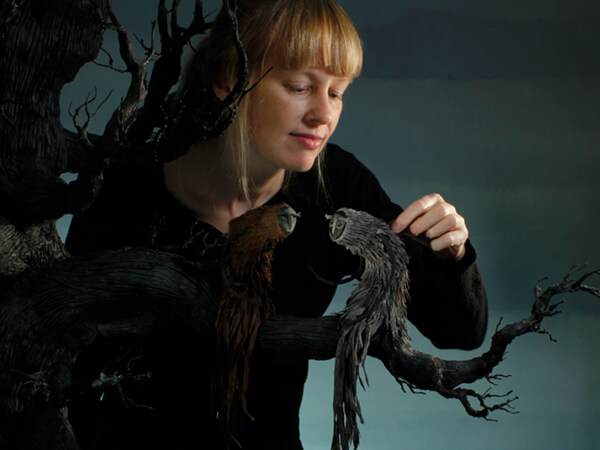
Image: Anne Breymann
Following from this, the credits for Radix mention assistance from the German Federal Film Board and the Berlin Senate Department for Culture and Social Cohesion. Can you tell us a bit about these organisations and how they’re set up to assist artists such as yourself?
I’m very grateful for both their support. The Berlin Senate Department for Culture and Social Cohesion provided me with a four-month artist grant, which gave me the freedom to explore different ideas. The first drafts of the story and design for Radix were created during this time. The production was supported by the German Federal Film Board through reference funding. This is a system where your film collects credits every time it’s selected in certain festivals, and those credit points can be turned into funding for your next project. So the budget I had for Radix was generated through the festival success of my previous short film Nocturne. It was still a very small budget though. I submitted Radix to two more film funding institutions, but got rejected.
We’ve previously featured your film Nocturne on the site, a film that shares many aesthetic traits with your latest film Radix that also proved very popular. Looking back on the experiences of both projects, what are some of the main ways you’d say you’ve grown as an artist and storyteller in the intervening years?
It wasn’t my intention, but I feel like Radix is somehow a continuation of Nocturne. They’re both situated in a world that I’ve been creating in my head over a long time. I feel very much at home in this world, and sometimes I need to escape there from reality and surround myself with strange and magical creatures. The experiences of both projects were similar, I even mostly worked with the same small team (sound designer Michal Krajczok and cinematographer Björn Ullrich). But I think over the years I’ve learned to trust myself a little more and just follow my intuition, and also to let go of control and trust the amazing people I work with.
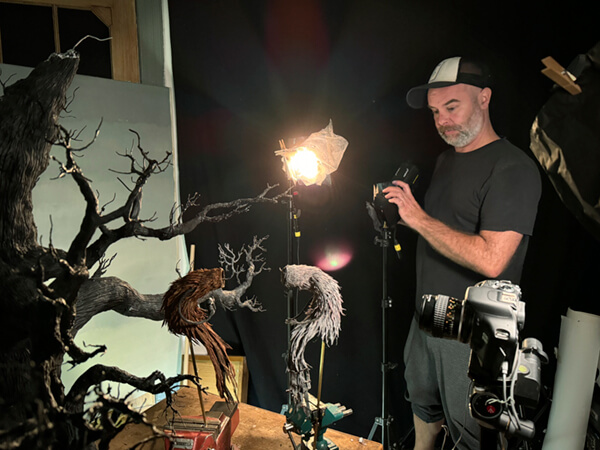
Cinematographer Björn Ullrich (Image: Anne Breymann)
Some of your other earlier work has used digital 2D and cutout animation; is this a medium you might return to at some point, or do you imagine yourself sticking with stop-motion films in the future (Ekke Nekkepenn, for example, appears to be a hybrid of stop-mo and 2D approaches)?
Most of my commissioned animations are done in digital cutout or hybrid techniques. This is mostly a practical decision to adapt to clients’ timeframes and budgets, and also to make it possible for me to work from anywhere. Ekke Nekkepenn, a short film about a dark Frisian folktale, was a commissioned film for De Kraak, a traveling multimedia exhibition featuring folktales from the sea. For this project I worked in a hybrid technique with handcrafted relief puppets from clay and paper, which I photographed, and then animated in the 2D animation program Moho. I don’t think I’ll ever stick to just one technique, maybe I’ll try live action puppetry next.
As well as animated films, you’ve produced stunning standalone pieces and posed illustrations using puppets. Does this go hand in hand with how you approach animated storytelling, or is it its own separate skillset to tell stories in single, static images?
It‘s my favourite way to tell a story in just one image, because it gives me so much freedom. I can create these photographs spontaneously, without the time, planning and budget I‘d need for an animated short film. I usually draw a very rough sketch, and then I just start creating. To me those puppet illustrations (I never really know what to call them) are like stills from a film that doesn’t exist. Maybe this sounds strange coming from a filmmaker, but I personally enjoy more looking at still than moving images, because I can take as much time as I want to discover all the details.
As mentioned, Radix continues in a similar vein to prior works in its embracing of folklore and mystic elements. Was the concept of its two main characters and their interactions rooted in any pre-existing mythology at all?
I’m very much inspired by mythology and folktales, but Radix isn’t based on any existing mythology, it‘s a rather personal story.
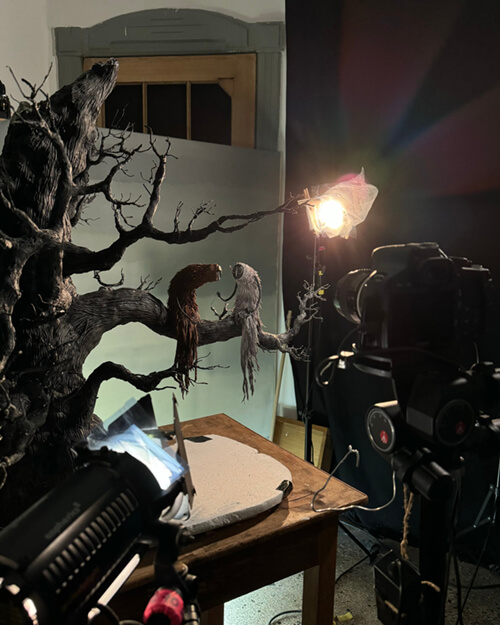
Image: Anne Breymann
It notably draws upon a recurring visual motif across your work wherein creatures and plant life appear to be biologically entangled – branches emerging from or within body parts, for example. Does this imagery hold any particular symbolism or weight to you personally?
My films are all created very intuitively, and sometimes I‘m surprised myself that I keep coming back to the same motives such as masks and roots. For me the branches stand for something rooted deep inside ourselves, something that changes and evolves, but is mostly hidden, and only comes out in certain situations. I‘m very much inspired by plants and animals, but also by everyday‘s human behavior and interaction.
When making this kind of film, do you pre-plan out the story in a traditional sense (script, storyboard) or is it more of a stream-of-consciousness approach? Or something different entirely?
It always starts with something visual, a drawing or a sculpture, which I create without a plan. The story and the characters develop simultaneously. I wish I could make the entire film this way, but once I get to the point where I apply for funding, I have to make a storyboard and precise plan. When animating I work with an animatic, but try to shoot as much chronologically as possible, so I can still be open to changes and new ideas.
-
- Image: Anne Breymann
-
- Image: Anne Breymann
-
- Image: Anne Breymann
From a technical perspective, I’d love to hear more about what goes into the crafting of the puppets themselves; do you use standard rigs and materials or do your films require something more bespoke?
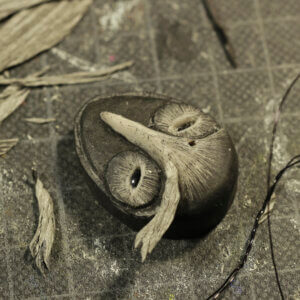
The puppets of Radix are actually made from very simple materials. The armature is built from wire, balsa wood and brass, the feathers are made from paper, and the faces are sculpted from polymer clay with glass eyes. I prefer to use materials that I can spontaneously adjust during the making, as the characters’ design often evolves while I‘m making them. I like my puppets to be visibly tactile, with imperfections and rough textures.
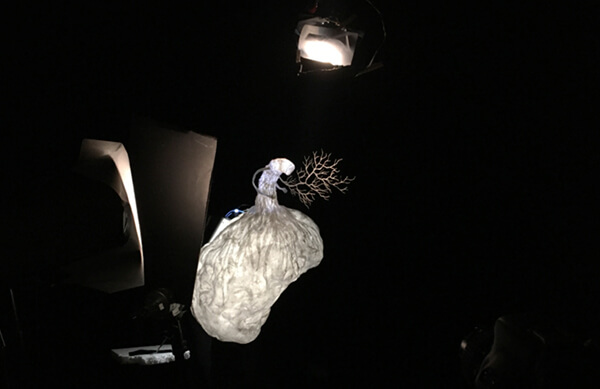
Image: Anne Breymann
The interplay of light and dark – indeed, the use of light as a whole – is fascinating to observe within the film. The internal lighting effects read as though they were created in-camera as part of the puppet designs themselves, was that the case?
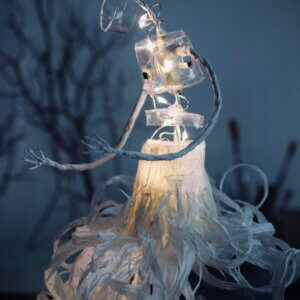
Most of the lighting effects are indeed created in camera. The glowing creature for example was made from white paper and transparent plastic with fairy lights and LED wires inside. The only lighting that was done digitally was the glowing of the leaves, because they were so tiny. I made them from paper and wire, and Jonatan Schwenk animated them one by one in stop motion, and later composited them into the film. The overall lighting of the film was done by cinematographer Björn Ullrich.
What sort of demands on your time and circumstances does a project like this have on you as an independent artist? Did you have access to a studio space/resources or was it a home setup?
I worked on Radix over the course of two years, while simultaneously doing commissioned work, and it was sometimes hard to juggle both. I’m very lucky to share a studio in Berlin with eight artist friends. Their company kept me sane while I was animating all day on my own behind black curtains.
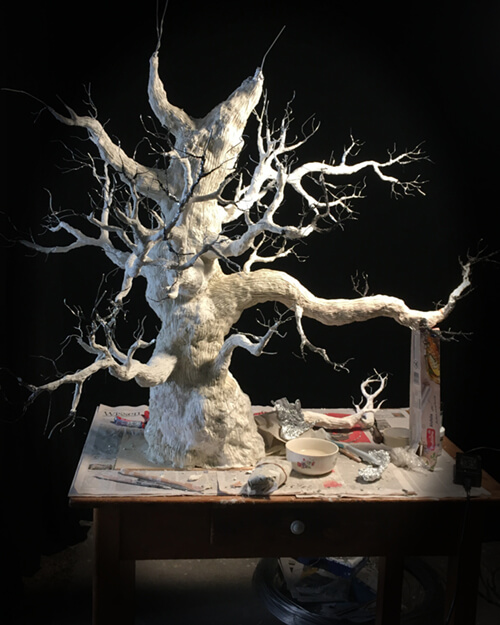
Image: Anne Breymann
From screening the film for recent major UK events including the Encounters Film Festival and Manchester Animation Festival, I’ve been able to enjoy firsthand an enthusiastic response from audiences. How have you found Radix’s festival journey so far, and has it yielded any valuable interactions/opportunities?
I‘m happy to hear that, as I‘ve only managed to attend a few screenings in person, but I hope I’ll have more chances to travel and actually meet the audience. Radix is running very well in festivals and received some awards. I get kind messages from people who have seen it in a cinema somewhere around the world, which always makes me happy. One of the good interactions that happened is this interview with Skwigly 🙂
Having recently qualified for Academy Award consideration following its recent win at New Hampshire Film Festival, do you have immediate plans for Radix as far as keeping it in contention (upcoming screening dates etc)?
Radix is a self-produced film, and I don‘t have the means for a campaign or screenings beyond film festivals. I think it’s already great to be on on the longlist, and don’t have very high hopes for more.
I‘m planning to release Radix online soon though. The trailer gained a lot of attention on social media, and I know that many people have been waiting to finally watch the film.
Beyond Radix, are there any other projects you have out in the world, or in the pipeline, that readers should keep an eye out for?
At the moment I’m creating narrative sculptures and creatures for several exhibitions next year.
For more on the work of Anne Breymann, visit annebreymann.de