

Bread Will Walk | Q&A with Alex Boya

Continuing a fruitful creative relationship with the National Film Board of Canada, Bulgarian-born, Montreal-based animator Alex Boya‘s latest film Bread Will Walk is an examination of ‘dystopian absurdity […] where the grotesque and poetic intersect’ told through 4,000+ hand-drawn, ink-on-paper frames embellished via a unique cocktail of digital and photocollage processes.
In a world where the planet is starving, a malevolent enterprise known as The Mill offers the solution of ‘miracle bread’ that turns all who consume it into bread themselves. When young Magret realises her brother has become one such bread zombie, she takes it upon herself to protect him from a ravenous, addled society at all costs and against increasingly frenzied odds.
With the film currently screening at International Countryside Animafest Cyprus and upcoming selections including the Ottawa International Animation Festival, Skwigly caught up with Alex to learn more about the project’s unique concept and visual approach.
We’ve spoken with you previously about your prior short film work Focus (2015) and Turbine (2018) – can you bring us up to speed with what you’ve been up to since then and how it led to the production of your latest film Bread Will Walk?
Bread Will Walk is a natural extension of my earlier works but began in another medium: with my graphic novel The Mill (Chapter 1): Walking Bread, completed in 2018. That world—circular, man-made, existentially industrial—felt like the logical next stage of my filmmaking after Turbine. I brought the concept to the NFB in 2019, and after some development positioning, I began production in May 2021. It was a four-year journey through analog, digital, and hybrid processes. The NFB’s creative environment allowed me to go deep into that process, treating animation as fermentation rather than manufacture.
Where did the concept of ‘nonviolent bread zombies’ originate from?
It began with a visual pun on emotional dependency. What if bread, the symbol of basic comfort and sustenance, could turn against us not with violence, but by absorbing our love? The zombies in the film aren’t predators. They’re lost beings made of our most familiar food, walking with ritualistic aimlessness. They mirror our own hunger, not just for nourishment, but for meaning, for purpose, for each other.
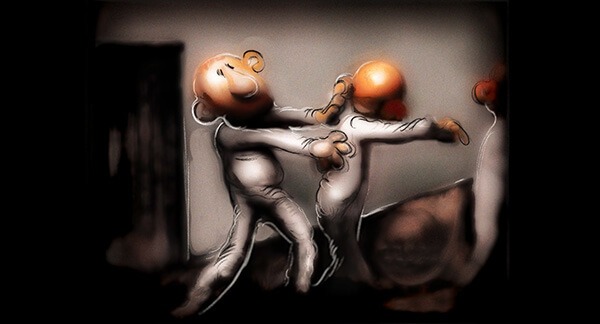
Image from Bread Will Walk – Courtesy of the National Film Board of Canada
Is ‘The Mill’ a stand-in for a particular organization or governmental body?
Not explicitly. The Mill is more of a behavioural schema than a bureaucracy. It mills not flour but willpower. Its shape is circular, suggesting inescapability. I wasn’t targeting any specific entity but rather mapping a structure we all internalize, the one that teaches us to sacrifice intimacy for productivity, clarity for belief.
Having worked with them previously in your career, did you always intend for this film to be an NFB production, and how did their involvement help get it made/developed?
Absolutely. After Turbine, the trust with producer Jelena Popović and the NFB was firmly in place. From the beginning, the NFB supported this film not just financially but ideologically. It gave me access to a collaborative space where invention and imperfection are valued. It also gave me time—four years—to knead the story, test methods, abandon others, and return to core instincts.
The film has a very specific, multi-layered visual approach. Can you tell us a bit about how you developed this and how it technically breaks down?
The process started with thousands of ink-on-paper drawings done straight-ahead, scanned and composited in Photoshop. I performed shape segmentation on each frame to isolate layers, skin, fabric, structures, before overlaying photo textures. Bread textures were collaged from real photographic elements, sometimes even baked, shot, and dissected. The final look came from digital compositing in After Effects, where Mathieu Tremblay created a custom “pastry glaze” blend of filters that softened harshness and gave the image a glazed, fleshy cohesion. Norman McLaren’s spirit was constantly invoked. Animation happens between frames, not just on them.
I remember seeing that, during the development phase, you were dabbling with AI. What ultimately led to you moving away from that path?
AI was useful as a preliminary texture generator, especially in-house tools I was developing at the NFB. But visually, AI has a flattening effect. It draws from statistical norms and delivers what you expect rather than what you feel. I didn’t want that probability grid dictating the emotional tone. We ended up using AI-generated outputs as references, volume, light, colour cues, and repainted or redrew them entirely by hand. I’d describe it as using AI as a prosthetic for imagining, not replacing, the artist’s gesture.
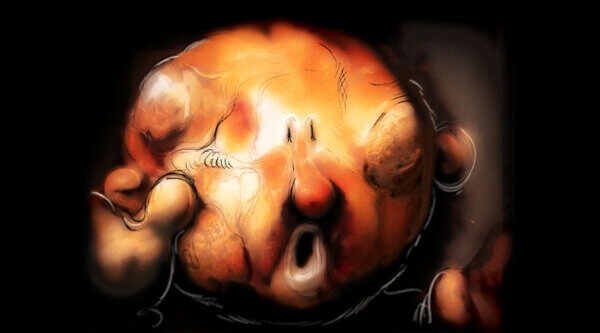
Image from Bread Will Walk – Courtesy of the National Film Board of Canada
In our last interview, you also mentioned that stop-motion might play a part in this project, then titled The Mill. Did any aspects of this approach remain in the final film?
We went fairly deep into it. We tested bread-based pixillation sequences, including 3D-printed bread forms and discussions about rigging real dough in a fireproof green- screen oven. But safety concerns (and the impracticality of baking frame-by-frame) meant we couldn’t continue on premises. Still, that inquiry shaped the logic of textures, lighting references, and rhythm. There’s a stop-motion spirit in the final piece, a stiffness, a tactile impulse, even if it’s entirely 2D.
The film makes use of a continuous ‘long take’ shot method occasionally seen in live-action and, rarer still, animation. Were there any particular artists or films/projects that influenced this?
In Turbine, I had already begun wrapping camera logic around the characters. This time, I committed to one uninterrupted take, a fresco rather than a montage. Béla Tarr was an influence, and so was the tradition of single-shot stage theatre. But technically, it was the absence of editing that interested me most: a psychological claustrophobia. The viewer isn’t allowed to look away. You are implicated in the breathlessness. That’s the trap.
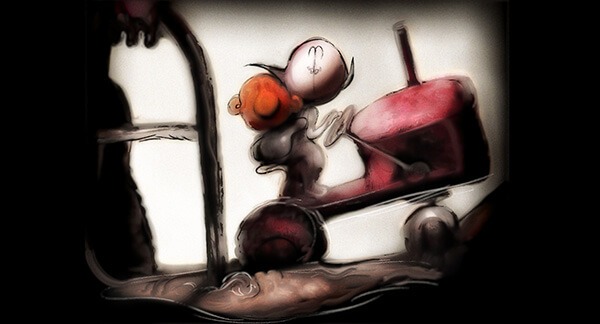
Image from Bread Will Walk – Courtesy of the National Film Board of Canada
Was there any particular significance to the film’s main protagonists being brother and sister?
Yes. Siblinghood embodies involuntary love. Gerben’s sister, Magret, shelters him not because she must, but because she remembers who he used to be. This relationship predates ideology, predates consumption. In that sense, she’s a kind of Antigone, trying to restore dignity to a body society has discarded. The brother, now made of bread, represents both personal loss and cultural rot in the zettabyte age.
How did you come to work with Jay Baruchel on the film and what was behind the choice to have him take on all the voices?
Jay and I first connected by phone, and I was immediately struck by his instinct to stretch a single voice across a fractured cast. His range isn’t just technical, it’s architectural. He sculpts entire worlds through tonal shifts. What stood out most was the rawness and pliability in his performance, which made the piece feel lived-in. By assigning every role to the same voice, we weren’t just blurring identities, we were building a sonic ecosystem, where each character feels filtered through the same worn machinery.
Previously you had mentioned scoring the film to Edvard Grieg—in the end Bread Will Walk is bookended by the classical Chopin piece Nocturne in E-Flat Major and the jazz standard All of Me, both interpreted by Martin Floyd Cesar. Can you tell us a bit about the musical direction of the film and working with Cesar to achieve it?
Martin Floyd Cesar brought a needed vulnerability. Grieg was too architecturally grand. Chopin and “All of Me” gave the film an emotional echo: one classical, one vernacular. Both pieces were interpreted as if overheard through a cracked window. Martin’s voice wraps around the final moments like a memory you didn’t know you had. The song “All of Me” became unintentionally literal. The crowd in the film wants all of Gerben. But also, Magret gives all of herself.
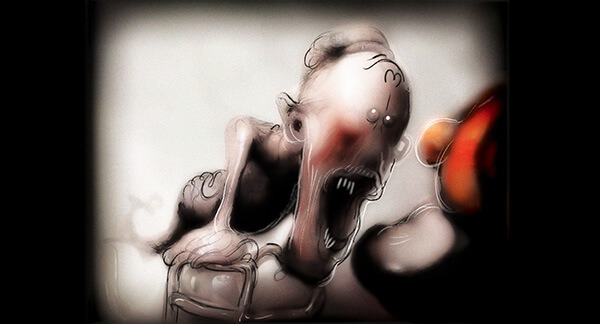
Image from Bread Will Walk – Courtesy of the National Film Board of Canada
The film premiered as part of the Directors’ Fortnight in Cannes in May of this year – how was that experience and has it opened doors for the project’s visibility and distribution?
Premiering at Cannes on May 22 was surreal. It’s not just about the prestige, it’s about context. Watching Bread Will Walk on a giant screen with an international audience, in silence, during the final scenes… that kind of reception reinforced that even the strangest concepts can resonate viscerally. Since Cannes, the film has screened at Annecy, and several upcoming festivals have expressed interest in the film. International interest in the distribution has increased significantly, especially from curators seeking hybrid or speculative animation. The conversations happening now wouldn’t have occurred without the visibility the Directors’ Fortnight provided.