

Savages | Interview with director Claude Barras

Tomorrow sees the UK release of Savages, a new stop-motion animated feature from director Claude Barras. His first feature since 2016’s enormously successful My Life as a Courgette, Savages is co-written with Catherine Paillé and Morgan Navarro and sees Barras look to his own Swiss heritage and its parallels with the Penan people of Borneo in its story of Kéria who, upon rescuing a baby orangutan, finds herself reconciling the industrial threat to the forest from the oil palm plantation that employs her father with her deceased mother’s nomadic family’s efforts to preserve it. Guided through the forest by her young cousin Selaï, Kéria finds herself coming to a better understanding of her indigenous family’s roots, conflicts and the environmental politics that led to her mother’s death. While produced at a grander scale than Courgette, with more elaborate production design, Savages retains Barras’s established track record of storytelling that puts the humanity of its characters first. Having premiered at Cannes and wowed audiences at festivals including Annecy last year, Skwigly were keen to speak with Barras ahead of the film’s UK theatrical run.
Firstly I wanted to briefly mention My Life as a Courgette, we didn’t speak to you about it back then but it was one of our favourite of that decade, can you talk a bit about how that film paved the way for Savages?
When My Life as a Courgette gained an unexpected level of success, my new agent, which had been Céline Sciamma, my co-writer on that film’s agent, because suddenly I needed an agent, gave me a sound piece of advice which was ‘Given the success of this film, now’s the time to make your dream film on the back of it’, so it was a chance to make a film that was really exotic and so far removed from my own experience.
Getting a long form animated feature made outside of the normal studio system has never been an easy feat, but today seems particularly hard. What was the journey like as far as getting this film made and funded, and how long did the process take overall?
In Europe, when you want to make a film whose budget will be about 8-9million euros, it’s fairly straightforward. Once you start to be a bit more ambitious, that’s when you have to start thinking more in a commercial logic or perspective. So I did think the theme of the orangutan might be a bit of a crowd-pleaser, and then I was still riding the wave of success with Courgette, so that helped me secure 12 million euros from France, Belgium and Switzerland. Now commercially it’s not as successful, I’d say, as Courgette, it’s not on the same scale. In Switzerland, to be honest it’s done well, in Switzerland for example in each cinema it’s had roughly the same number of people, but fewer cinemas will screen it across the board. I think this is also due to the fact that it’s been presented in terms of a militant film, or an environmental film, which sadly suffers sometimes from bad press or tends to put some of the exhibitors off. The other thing that’s happened since is that there are just more animated films being released, so essentially the film is competing with them, each film finds it a little bit harder to find its place in that market.
It would be great to hear a bit about your personal connection to the characters and story at the centre of Savages?
My grandparents had lived what could be called a semi-nomadic lifestyle, which meant that in the summer they would go to the Swiss alps with their flocks of sheep, then in winter they would go down back to the village, down the mountain to tend to the gardens and the vines etc. And that way of life really changed so much after the 60s, when I was born, so I ended up growing up in town, in an urban setting, so there is an exotic element of the film but it does hark back to that lifestyle that my own family had known. The other thing was, in a world where things keep changing and evolving so fast, I wanted to question what can be transmitted in terms of values from one generation to the next.
Thinking of how that experience translates to the setting of the film in Borneo. Have you spent time there, either for this film or in your general life?
The centrality of the figure of the orangutan is due to the fact that they are an endangered species, there are so few wild orangutans still alive, and I wanted to question our relationship as human beings to nature, and I thought the orangutan is one of the animals that would have a large appeal to children. So all these ideas came together and these wild orangutans live in Borneo, so that’s how Borneo came about as a location, and then I found out that the Penan people are engaged in a fight to preserve their environment and against deforestation so I went there myself and immersed myself in their way of life, to better understand it. I basically replicated Kéria’s journey in order to better tell that story.
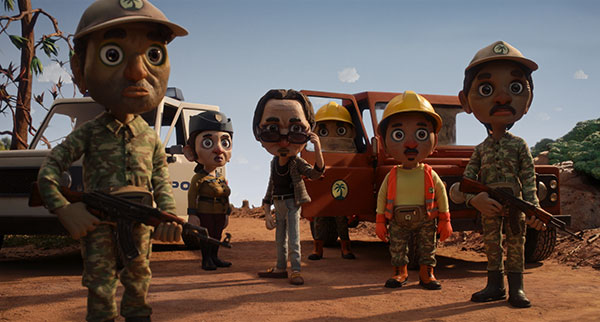
Savages (Dir. Claude Barras, MetFilm Distribution)
You wrote the script with Catherine Paillé and Morgan Navarro, how did you all come together on the project and were there specific aspects of the story each of you brought to the table?
So at first I worked with Morgan Navarro on creating the dialogue that would be specific to each character, and then I did work with Nancy Huston to develop the relationships between the characters, and then came a third phase where I worked with Catherine Paillé on the script, on constructing the story. She’s quite experienced in the world of documentary, and because there’s quite a strong documentary element she brought a lot of her experience to the table. And that phase took two years, because at the level of financing there was a lot of back and forth where we would send off a version of the script to readers and they would send their feedback back, so there were roughly ten versions but divided up into three big chunks, three phases of that writing process.
Given our current ecological and economic situation in the world, did you feel that it was especially important to tell this story now?
When I started to look at the topics of the extraction of palm oil and the consequences of that and deforestation, exploitation of resources, I ended up getting quite depressed because the power imbalance was so obvious between the people exploiting those resources and the people trying to fight back. But in a way, that’s not to deny that there are small victories, that there are people trying to resist, trying to fight back, and therefore it makes making this film about these people all the more necessary, because it allows us to highlight the importance of what they’re doing, the impact of deforestation, not only on biodiversity but on our collective futures as we see through the effects of climate change that we’re feeling already. I’ve also tried to change my own lifestyle to try as much as possible to accommodate that, I no longer have a car, I cycle everywhere, try to grow my own vegetables and so on.
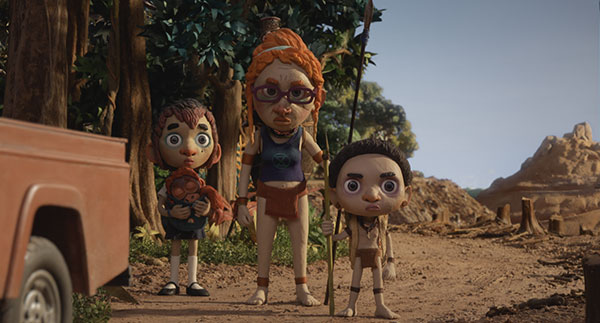
Savages (Dir. Claude Barras, MetFilm Distribution)
An aspect of the film I thought was interesting is that it isn’t anti-technology, insofar as phones and social media actually have a valuable function in rallying people to a cause. Was that a specific message you were hoping to convey?
I went in really wanting to be fully engaged in that fight against modernity, but then I took a bit of a step back. I’m not rejecting modernity; there are beautiful things being made, especially in science, and the real issue isn’t technology itself, it’s the power dynamics and the way that technology is used. In fact, that’s when I started to think of technology as a potential weapon of resistance. When we looked into it, to give you an example, the Penan community uses drones to track the illegal logging of the forests and to draw maps of that, and in the forest they leave messages to each other, not just with leaves and so on, but using WhatsApp. So I didn’t want to give this completely idealised version or vision of this community. This hybrid-use of technology and nature I thought was very interesting and bred creativity.
Were there any creative or technical aspects of the film that were particularly unique or difficult to complete?
The first technical difficulty was creating the soundtrack of the film, because we had to have a French actor speaking Penan. So we had two women, a mother and her daughter, in France, from the Penan communities, who helped coach the actors. The second one was to respect the natural sounds of the area; the film is actually being screened to the Penan communities throughout July using portable devices, and we wanted these audience to feel like we’re representing their environment accurately, so what we did was to send a sound designer to record all the sounds of animals, the sounds of nature and we played them in a way that respected the natural schedule or timeframes of those sounds, so which animals you would hear in the morning, which you would hear at noon and in the evenings, I wanted to reproduce those.
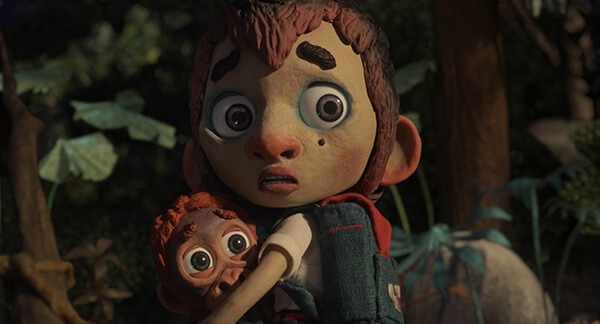
Savages (Dir. Claude Barras, MetFilm Distribution)
You mentioned about the importance of the orangutan and appealing to younger audiences, I’m interested in how you’ve found younger audiences have responded to the film. Do you feel that it’s reach them?
When I have an audience of children aged around 8+, they always have a lot of questions about how to help, how to support the orangutans, how to support the Penan communities, what do we do about this, et cetera. So we actually set up a website with the help of five NGOs that have educational materials and resources for those children and their parents to use. For younger kids, it’s a bit more tricky, because some of the themes – like the death of the mother – are quite hard. It really depends on the parents, how they are framing the film and how they’re watching it with their children. I’ve had parents come up to me and say “we don’t think this is appropriate for younger children” because of the political content, so it really depends. But, as with Courgette, what I like to do is make films that create dialogue within generations.
Savages is out in UK cinemas August 1st