

INBETWEENS Filmmaker Focus: Jessica Meier

Bristol Animation Meetup (BAM), an initiative of Skwigly Online Animation Magazine, Rumpus Animation and Sun & Moon Studios, has teamed up with Bristol’s Encounters Film Festival and Cube Microplex on July 8th to present INBETWEENS, a special celebration of queer animation cinema.
Curated by local animator Luzie Ilgner, the screening showcases a playful, heartfelt, and thought-provoking mix of animations that either explore LGBTQIA+ themes or are created by queer artists.
What hides behind those masks, the leather and the rubber, and who can help me fix my pipe?
-(Pipes 2022, Presskit)
Ahead of INBETWEENS we had the chance to dive deeper into the journey of Pipes (2022) – one of the films from the queer screening’s programme. Pipes was directed by the filmmaker trio Jessica Meier, Kilian Feusi and Sujanth Ravichandran. We caught up with Jessica Meier and had a chat about her role in the film team and the making of Pipes.
Tell me a little bit about yourself and your animation journey!
I am one of the three directors of Pipes, our graduation film at the Bachelor’s programme for Animation Film at the University of Lucerne in Switzerland. I came to animation by accident. I always loved drawing and wanted to be an illustrator for a long time. When it was time to get into art school I went to visit the universities and ended up going to the animation department, pretty much by accident. I then thought that this was so much cooler than illustration. So I applied for it, got in and moved to Lucerne where we made the movie together. We are still friends, of course, but we have gone our separate ways and are all working independently now. Kilian is working mostly in sound now and doing some animation while also trying to pitch for his film. Sujanth is currently taking a break from animation and is doing more technical work. I did a little bit of freelance work last year and now I am trying to work on my own new film. It’s in very early pre-production stages and mostly just an idea.
In your own words, what is Pipes about?
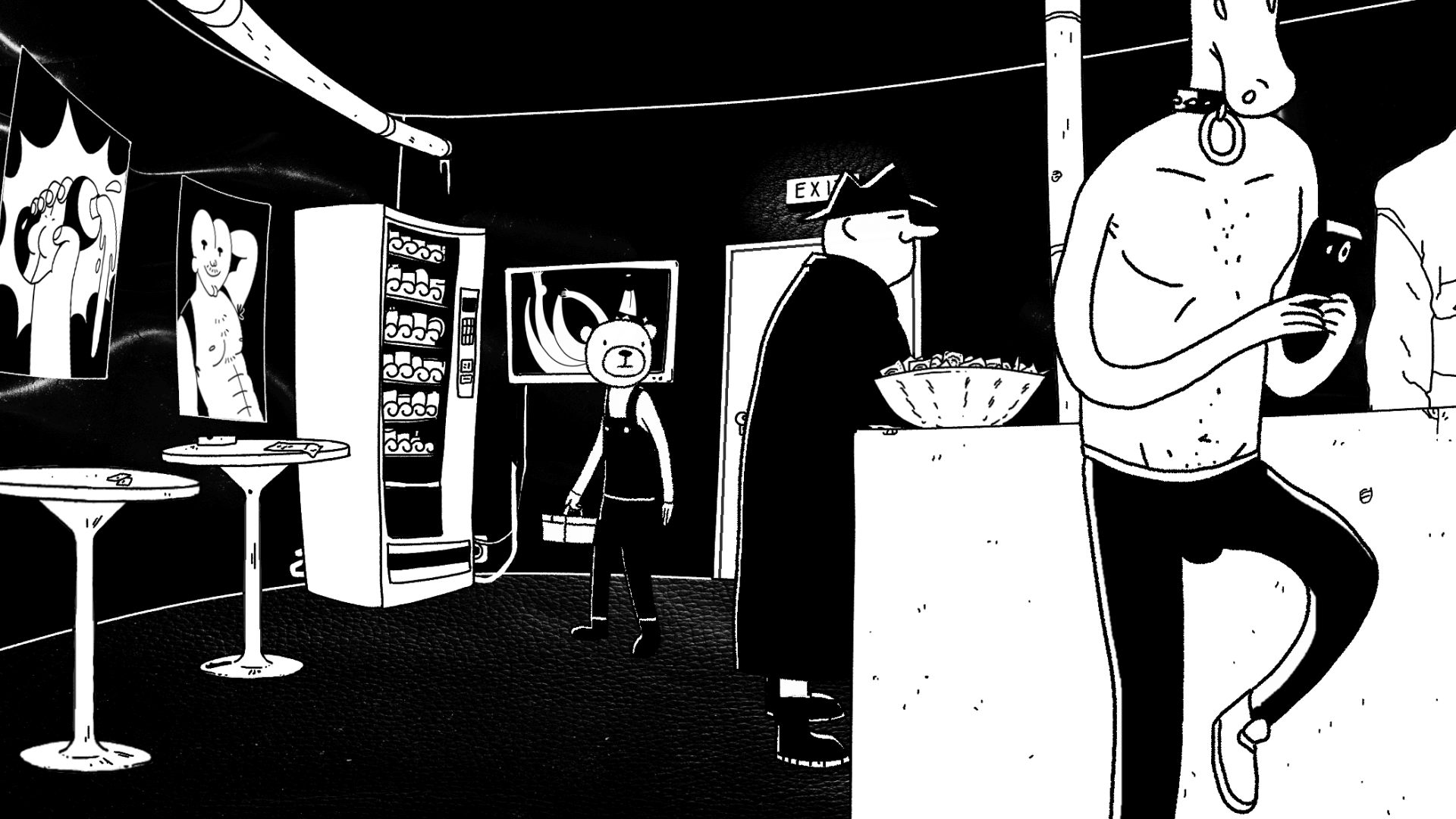
Pipes is about a plumber that needs to go fix a pipe in a gay fetish club and he goes on an adventure in there.
And he comes out transformed..
It’s like a little hero’s journey!
Pipes (Dir. Kilian Feusi, Jessica Meier, Sujanth Ravichandran)
Where did the idea for the film come from and how did you form the team?
How it works in our school is that, over the summer, you prepare a pitch for a film that you would like to do as your graduation project. I pitched something and Kilian pitched the original idea for Pipes, which was quite different, but the setting of the gay club and the teddy bear protagonist was the same. At the time it was a much more serious – and less sexual – idea; it was more about male loneliness and questioning your sexuality. Sujanth didn’t pitch. He wanted to work mostly on action shots animation. The teachers looked at all the pitches. Because of time and budget restraints of the school not every project can get made, so you have to team up. The teachers basically sat us down and said “Hey Jess and Kilian, your ideas sound similar, you seem to have similar things to say, how about you guys get together and work on either of your projects?” Then we formed the trio and decided to work on the idea of Pipes.
Your film is inspired by a personal experience. Could you elaborate on this?
The idea of Pipes is inspired by something that happened to Kilian. The club [in the film] is also based on a real club that existed in Zürich. It was called Rage and closed down during the pandemic. Before the pandemic, there was a night where Kilian was out with his friends. They went to several clubs and also ended up going to that gay fetish club. Kilian is gay but wasn’t into the fetish scene, so he had this very vivid experience of going into a space where he should technically belong, but he felt very out of place and insecure about his body and about the things he saw. He felt so alienated at that time that it made him really think about his place in the community.
Is this personal experience also the reason why you chose this super cute and innocent-looking teddy bear as a main character?
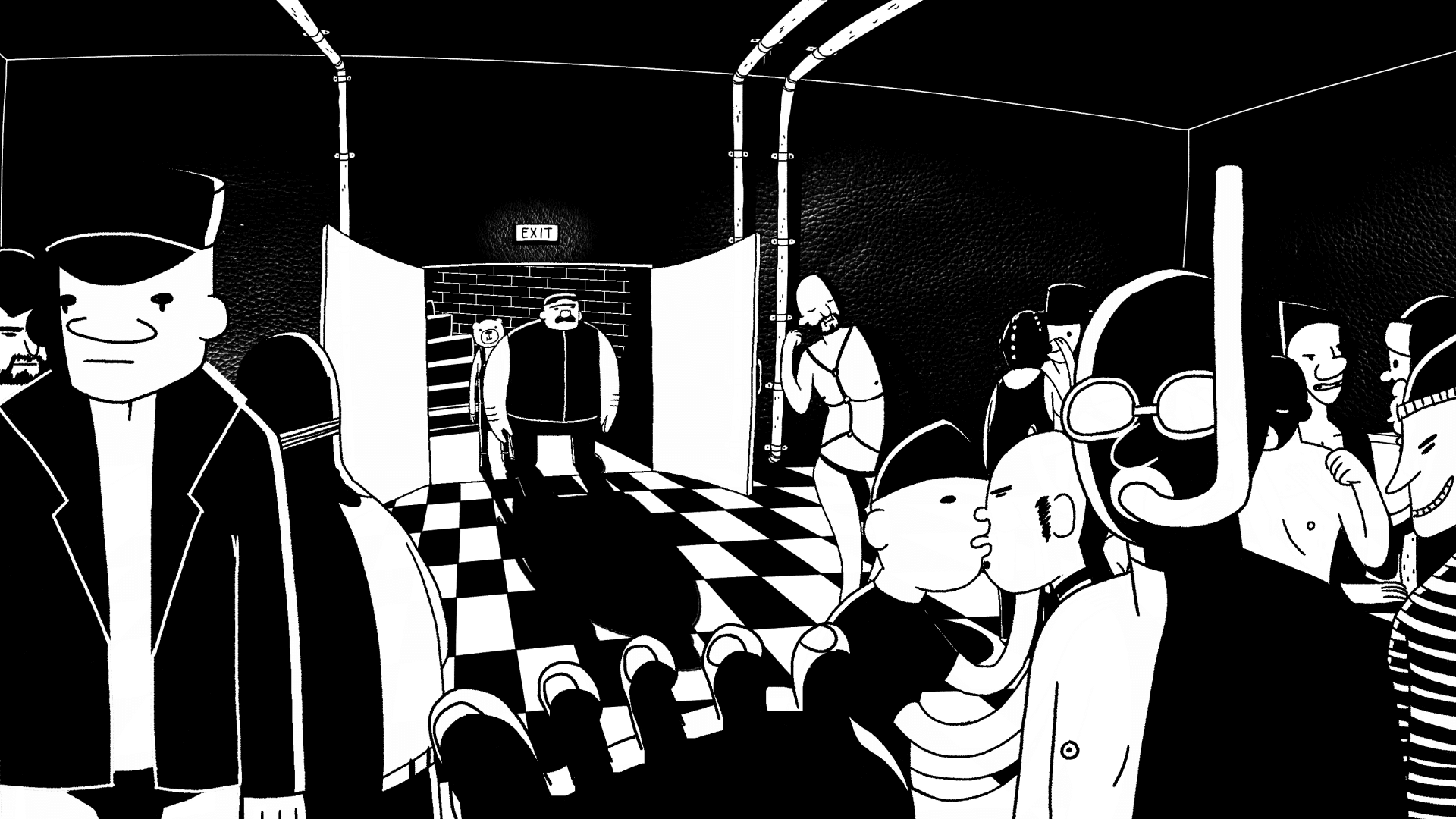
Yes, very much. It’s also because of the gay male archetype of a bear. A lot of the other characters in the film are sort of representative of different kinks. There is a foot character, there are people in uniforms and swimsuits. All of the characters are sort of different nudges to different aspects of gay fetish culture.
Pipes (Dir. Kilian Feusi, Jessica Meier, Sujanth
There is a lot of visual overlap between the work of a plumber and activities that might occur in a gay fetish club in your film. What was interesting about creating the crossover of these two realms?
It’s just very funny. This “handy work world” feels at least to us very straight, very “macho”. When you contrast that with this flamboyant, gay culture, we thought clashing these two worlds together would be very funny and interesting. And the imagery of a pipe – you can do so much with that if you take this phallic shape and create associations. That is how all the jokes and the visual jump cuts were born.
Did Kilian, Sujanth and you have different responsibilities working on Pipes?
Yes! It was very important to us that we did the directing together. Every story, look and vibe-based decision was made together. We all animated a little bit. I animated the least out of everyone because I was also working on the backgrounds and I was also the line producer, so I organised the funding, the behind the scenes, the helpers and pipelines. Kilian is a very fast and good animator, he animated the most. Sujanth did the “big money shots”. We all did a little bit of everything, but it was distributed differently. I think the way that we worked together on Pipes, where everyone had something to say but also respected the other’s opinions and ideas was truly an ideal situation. I hope to recreate that situation.
You mentioned you made the backgrounds, how did you come up with the very distinct visual style of the film?
The original poster that Kilian drew for the pitch was also in black and white. The very bouncy and flowing style of animation we wanted to create takes a lot of time to animate. Having colours in the film takes also a lot of time as you need to work out the colour keys and colour concepts. We wanted to avoid that. The theme kind of lends itself to this black and white style. When I was designing the backgrounds we were drawing style frames to see what a finished frame of the film could look like. We had these big crowd shots with the main character, fifteen different moving characters and the background itself and it became completely unreadable. I came up with the idea of adding leather textures in the background. Everything else is flat, black and white with a little bit of shadow and highlights, but then you have these really organic textures in the background and that made it visually much easier to read what was happening. We had an amazing compositor, Marco Jörger. He mainly is a stop-motion artist and he took pictures of different leather that he found and then animated it in stop motion. He then composited it into the background.
How has the audience reception watching Pipes been so far?
It was very mixed, I would say. It has been very successful, so overall I would say it has been positive. In terms of audience reaction, whilst you’re watching it, it’s been all over the place. We’ve had screenings where we had a lot of laughter and everyone found it super funny. Then there were other times when it was screened at other festivals and there was just dead silence and I was feeling so uncomfortable. So yeah, we had a little bit of everything, but it has been amazing so far!
What is your perception of the Swiss animation industry, and how open is it towards queer themes?
The art scene in general is very queer-friendly, at least from my perspective. I am obviously in the queer bubble. I might have a skewed perspective but I feel like it is quite open. There is not really an animation industry in Switzerland, so we don’t really have that. There are a lot of small-sized, independent studios or collectives of artists, but there is not really an “industry” as you would have it in France, England or in some parts of Germany and of course in Asia or America. A lot of people that work in animation are freelancers or independent filmmakers who try and secure funding for the next project. We are very lucky to have pretty good funding for the arts, depending on where you live. We also have the GSFA (Groupement Suisse Du Film D’Animation) which is the Swiss Organisation for Animated Film. It is a huge help and really works hard to ensure that animated independent film lives on in Switzerland. We’re very proud to have that and it’s growing steadily. People who really want to go into the “industry” usually have to leave Switzerland or work remotely for a foreign studio, but there are also more and more people trying to build up something here and band together as a studio or a collective.
What has been going on in your creative life since Pipes?
I have been doing a project for a festival that wanted me to animate an opening sequence for them and I have also been asked by a game studio to animate parts of their trailer for their upcoming game. These were gigs I worked on, but I realised after a year that I don’t really enjoy freelancing for projects that I don’t have any creative control over and I really want to focus on my own projects. In my free time I draw, I try to go to festivals, I watch a lot of movies and I am also a programmer for my local queer film festival The Pink Panorama in Lucerne. It’s happening every year in mid-November and we are currently working hard to finalise the programme that will hopefully be released in August.
Pipes will be showing at INBETWEENS – Queer Animation Screening at Cube Microplex in Bristol 8pm on July 8th in association with BAM/Encounters, and at Cardiff’s Chapter Arts Centre 5pm on August 23rd in association with Skwigly/CAF.
To keep up-to-date with BAM’s current and future events follow @bristol_animation_meetup on Instagram.