

The Obsessed | Interview with director Wataru Takahashi

On the cobbled streets of a European location that could be anywhere but is nowhere in particular, the fresh-faced and bright-eyed Giuseppe (Masaya Sano) is a young man about town. With bushy ginger hair, an Italian name, and a mouse best friend, his life is somewhat Ratatouille in flavour — but Giuseppe is outgoing and bold. He’s known to friends, family, and neighbours as ‘The Obsessed’ – he flits from one passionate pursuit to the next. Life is a dream, rendered in kaleidoscopic colour and celebrated in bursts of song (it’s a musical!). Then he sees her – and his world stops. A balloon seller in the local park, she says her name is Pechka (Moka Kamishiraishi). The two strike up a friendship, but it becomes all-consuming for Giuseppe. Obsession isn’t so straightforward when it’s obsession with another person.
Wataru Takahashi’s film is a delight — dazzlingly and sincerely grappling with questions of love, limerence, and idealised identity. Takahashi is a veteran director at Shin-Ei Animation, a prolific studio best known domestically for a reliable stream of Doraemon and Shin-chan theatrical feature films. Takahashi has previously helmed Shin-chan features, and The Obsessed (Toritsukare Otoko) is his first directorial effort outside of that franchise. In recent years, Shin-Ei has produced exciting and fresh films such as Totto-chan and Ghost Cat Anzu. Much like those works, The Obsessed has a striking and distinctive visual style. Characters are drawn in thin lines filled in with block colour, their angular, wonky lines resembling shapes that you might arrange in Microsoft Paint on an idle afternoon. It’s a fitting look for a film that’s an ode to imagination and daydreaming.
Skwigly had the pleasure of sitting down with Takahashi during the Tokyo International Film Festival, where The Obsessed was screened. In our interview, which leaps from topic to topic much like Giuseppe, we discussed the many joys and challenges of animation, adaptation, and romance.
Where did the idea for this film emerge from?
It started out as a short story of the same name, by Shinji Ishii. We approached him to discuss adapting it.
Why adapt it into a musical?
I wanted to deliver joy that can only be experienced through cinema. Giuseppe is obsessed with all kinds of things, and it made sense for him to express that level of obsession in the film through song and music.
What was it about the short story that made you think this could be a successful film?
The actions this character takes, the way he behaves – these days we don’t really have a character like this. We tend to think about blending in and cooperating with others, whereas this Giuseppe goes his own way – he runs wild, possessed by all these passions. I thought it would be really fun to bring this character to life on screen.
Tell me about casting Masaya Sano as Giuseppe.
We wanted to make a musical, so we needed someone who’s good at singing – that was the initial reason. This Giuseppe character is kind of a naive, innocent guy – but he’s also very open. He has this ‘trickster’ quality to him, and he’s very charismatic. So we got to thinking: “What kind of person could embody this character?”. I was recommended Sano-san. I remembered seeing him on television, where he’d crack jokes. And our film also has a comedic element. So I thought “Okay, he’s the right person”.
Tell me about the setting of the film and your visual approach to it. It feels somewhat indistinctly European. There are echoes of films like Ratatouille of course, but also the Professor Layton series and the Sylvain Chomet film Belleville Rendez-vous.
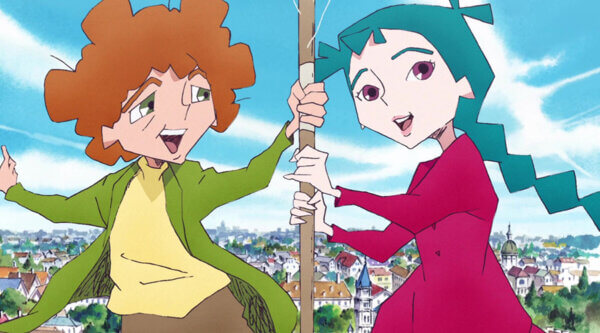
The protagonist’s name is ‘Giuseppe’, so he obviously comes from a foreign country. In the original story, where exactly was left up to the imagination of the reader. But I was envisioning the UK. And I thought it would be nice to create a town setting – indeed, much like we see in Belleville Rendez-vous. It looks how Japanese people imagine Europe to be.
©2001 Shinji Ishii / Shinchosha ©2025 The Obsessed Production Partners
There’s an angularity to the character designs in this film, and a charming scrappiness to its diversity of art styles. What was the starting point for the look of the film? That angularity reminds me somewhat of your work on the Shin-chan films.
Masatsugu Arakawa was responsible for the character designs – a first-class creator in the Japanese anime industry. He was involved in a series called Windy Tales (Fūjin Monogatari). So everyone in the industry knows him well. We thought it would be right to request his character designs, because this is in many respects a ‘fantasy’ story. And indeed, as you note, I do think I have been impacted and influenced by my past work on the Shin-chan films.
Looking back over Shin-chan and recent Shin-Ei efforts such as Totto-chan, Ghost Cat Anzu and this film, there appears to be no such thing as ‘conventional animation’ at Shin-Ei Animation – if indeed such a thing exists at all. Is there a design philosophy and culture at the studio where they strive to create original, atypical works?
I don’t think there’s really a set philosophy at Shin-Ei. They’re best known for characters such as Doraemon and Shin-chan, and those are both manga properties – and what that means is that Shin-Ei’s task is to replicate the mangaka’s world in film form. But with their original films, I do think that what they strive to achieve is a powerful uniqueness with each work.
Is this film hand-drawn, computer-animated, or a mix of both?
We drew it by hand, scanned it, then worked with the results on computers – that’s how the production process has evolved. We did have a tiny bit of 3D CG – the butterfly, and the falling leaves – but Masatsugu Arakawa was against it. He said it’s better to hand-draw.
You acutely and accurately capture romantic obsession in this film. Do you feel there’s something about cinema or animation specifically that lends itself well to exploring that subject?
Yes, I do. The original novel was very detailed in capturing how this guy – obsessed with so many things – begins to encounter romance. The writing was very straightforward about the way that he acts and open about the way that he thinks. Giuseppe is a straightforward character, and I thought that would look good in animation.
Who is your expected or intended audience for this film?
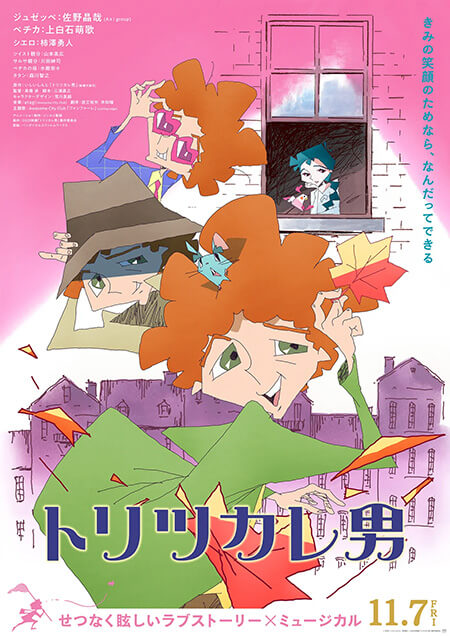
I feel it’s targeted at everybody. Shinji Ishii’s original work started out as a children’s picture book, but there was so much content to it that it became a novel. I think that evidences the fact that Ishii had so much to say – that there was so much emotion and power contained within his words.
©2001 Shinji Ishii / Shinchosha ©2025 The Obsessed
Would you describe yourself as “obsessed”?
Well, yes – I was obsessed with creating this film, The Obsessed. Now that it’s completed, I’m having more fun helping raise my kids.
What would you like your audiences to take away from this film when they leave the theatre?
Sometimes fiction can be more powerful than reality. Right now, around the world, war is going on. I don’t want people to lose against the feelings that that situation induces in us. I want to help support people mentally with films like this one – because film saved me.
The Obsessed screened at the 38th Tokyo International Film Festival. With thanks to Naomi Ikezawa for translating.