
Anfield Road | Q&A with Chris Shepherd

A long-established mixed-media filmmaker, last year saw Chris Shepherd redirecting his visual arts skillset – that has given the world such films as The Broken Jaw, Dad’s Dead, Silence Is Golden, The Ringer,Who I Am and What I Want and Johnno’s Dead among others, including music videos and contributions to cult comedy series Big Train and Nathan Barley – toward the creation of his first graphic novel. Released through Titan Publishing, Anfield Road tells a coming of age story centered around growing up in the working-class dynamics of Merseyside in the late eighties.
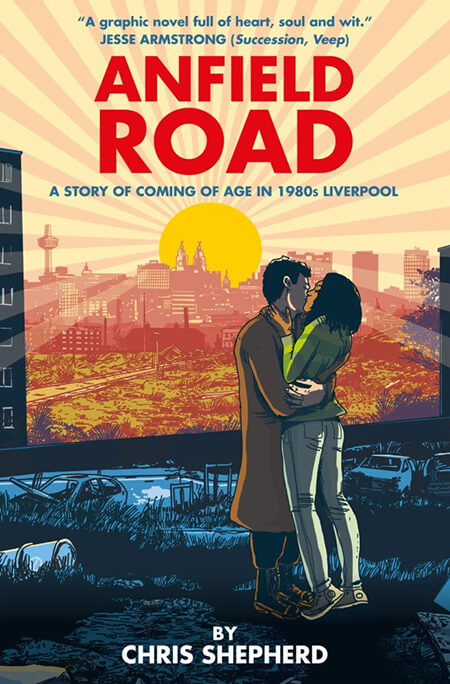
Conor lives at home with his Gran on Anfield Road, Liverpool. Life is routine — Findus Crispy Pancakes for tea, drunk scallies on the way to the footy, and a school that’s more like a prison.
But Conor dreams of getting out, going to art college in London with his girlfriend Maureen… but he’s terrified of leaving his sick domineering grandmother behind and striking out on his own.
What follows is a Northern Fantasy, as Conor navigates bigotry, sickness, and being true to himself, all against the glorious backdrop of 1980s Liverpool.
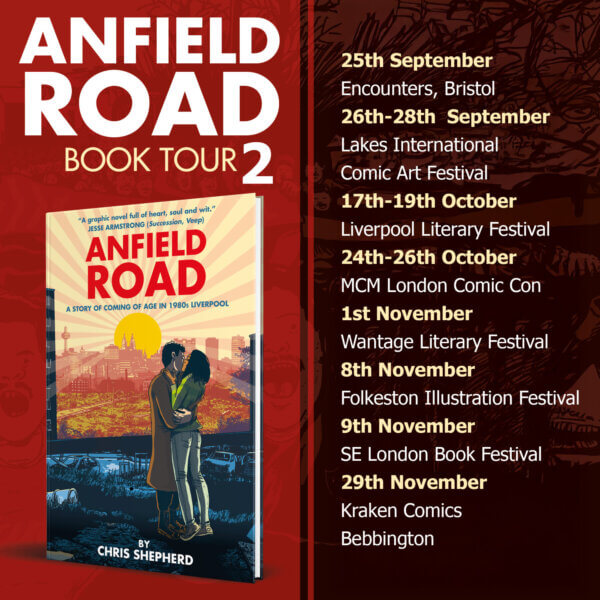
Ahead of the next leg of his book tour, which begins this Thursday (Sep 25) as part of the Encounters Film Festival, Skwigly caught up with Chris to learn more about Anfield Road‘s origins, development and ties to his earlier work in film and animation.
You’ve made many films over the years and you’re known for your eclectic work that spans live-action, animation and hybrid work that is deeply funny, whilst also often being quite dark. Having had the idea as a script for a number of years, I understand you worked on the novelised version of the story for four years. What prompted the change in medium?
I had initially tried to make the project as a film. I wrote a feature-length script and pitched it, but I could never secure the funding. Then lockdown came, and I found myself with much more time to draw. Feeling determined, I decided to tackle the entire project through drawing.
Initially, I was apprehensive about working alone because I enjoy collaborating with others. However, once I started drawing, I discovered that I truly enjoyed the process. Although I had spent time drawing before, this time I could see my skills improving, which was incredibly exciting.
At the end of the day, a story is a story, and it doesn’t matter how you tell it. You just have to get it out there. Whether it’s a painting, an installation, a film, or a musical, what matters is that you communicate something to the audience.
When I started in animation by making a film called “Safari”. I only animated because I didn’t know any actors and didn’t have a camera, so I made my characters out of plasticine. For me, the story always comes first; the medium is secondary.
You’re not a football fan yourself, but the film is set against an important event both in Liverpool’s and football history – why did you feel this was important to document and what do you feel it reflects in Conor’s own journey?
I always felt like an outsider growing up. I didn’t watch EastEnders, Coronation Street, or go to the football matches like everyone else I went to school, with. I guess I was the arty Scouser who liked to draw pictures and play music. I thought it would be interesting to create a character who felt like an outsider as well. Someone who, upon seeing everyone else heading to the football ground, wanted to go somewhere else.
As the story progresses, Connor develops an appreciation for football, but it’s something he has to experience firsthand. Football is very much a part of Liverpool. In fact, you can’t really have a story about Liverpool without mentioning football. The game’s influence on the city and its people is unmistakable.
The book shows a development in your own art style and has an energy and immediacy akin to Reportage Illustration, how did you develop this when representing a Liverpool of the past?
I think the more you do something, the better you get at it. That was certainly the case with my drawing. I drew and drew, and my drawings just became stronger. As an animator, I felt like I didn’t really have a style. I always saw myself as an animator-actor who uses his animation skills to create different stories and characters. For years, I never saw myself as having a distinct style. One minute I’d be doing children’s commercials, like those hedgehog road safety ads, and the next minute I’d be directing something truly dark like “Dad’s Dead.” The audiences for both projects didn’t really know about the existence of my artistic counterparts, which is probably just as well.
Back in 1998, I visited Paris and came across the work of Jacques Tardi. His cartoon books were truly a revelation to me. They were quite realistic in style, but at the same time impressionistic. I was particularly taken with his Nestor Burma books—they’re just beautiful. When I saw them in a bookshop in Paris, I thought, “If I could draw in any style, I’d like to draw like Tardi.”
In 1998, I made a postcard that was my own take on Tardi’s style, which showed Santa Claus arriving at Liverpool Lime Street on a train. This was something I always wanted to do, but instead, I explored many different styles, such as hybrid animation and live-action 2D, and never went back to that cartoon style until I started working on “Anfield Road.” Another key reference for my was my 1997 film “The Broken Jaw” in which I used different colour palettes for each story section. This is something I brought back for “Anfield Road”.
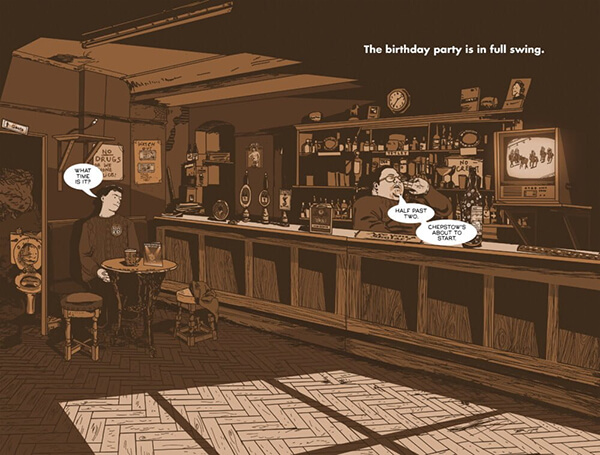
Anfield Road (Chris Shepherd/Titan Publishing)
The book has being doing really well and is already in its second edition. You’ve been very proactive in getting it out there. How have you found the response and do you have any highlight from its journey so far from events or people who have read/commented on the book?
It has been an amazing experience to publish the book. I never imagined I would ever do this. When I got the book out there, I saw it as my one chance to get people to look at it. I felt like I was back in that position of not knowing what I was doing, similar to when I first started working in animation. The first film I ever made, “Safari,” back in the 80s, was created with little knowledge. I ended up cutting it down from an amazing 12 minutes of animation to just two because I didn’t know any better.
With “Anfield Road,” it was the same thing. I didn’t know what I was doing and just launched into creating a 272-page graphic novel. I had no idea how much time it would take to draw. The same went for publicity—I had never done a graphic novel before, so I approached lots of people to see if they wanted to cover it or if it might interest them. The team at Titan really helped me out, and ultimately, it was a lot of fun to get the book out there.
I’ve had some great interactions with people from Liverpool about the book, which is really emotional for me since it’s my hometown. Many people have come to me with pictures of their houses, showing me where they lived on Anfield Road and sharing stories about their lives. It’s really exciting. One person even showed me a picture of a dolls house that their grandfather had made, which was based on a house on Anfield Road. I looked it up on Google Earth, and the dollhouse was incredibly accurate. That was truly amazing.
It’s incredible when a piece of art you create can have an impact on the real world. That is what creative expression is all about.
You’ve also been running the highly successful Bar Shorts with creative partner Dave Anderson (Dog & Rabbit) at London’s Garden Cinema for a number of years, through which you hosted a screening of Willy Russell’s 1977 Our Day Out with Alexei Sayle, who has been a great advocate for the book. Can you tell me bit more about the screenings and yours and Dave’s plans for Bar Shorts moving forward?
When I was writing the book, Titan – the publishers – asked me to get some endorsements. I thought about asking Alexei, as he is a comedy hero and grew up in Anfield. During my time working in TV, I seldom met anyone from my background. Film and TV tend to be populated by non-working-class people. The only people I could think of from Anfield in the business were Alexei and Alison Steadman. I had never met Alexei, so I got in touch with him, sent him the manuscript, and he endorsed it. Later on, he even wrote a foreword for the book! He has been very generous to me and the project.
The foreword sets the scene really well, describing how beautiful Anfield is. That was something I wanted to convey with the book—the idea that there is beauty in the everyday life of 1980s Liverpool. When we launched the book, we thought it would be a great idea to show one of the big inspirations, which is Willy Russell’s Our Day Out. The story of Our Day Out focuses on a group of Liverpool schoolchildren going on a trip to a zoo in Wales. I remember seeing it for the first time in school when it came out in 1978. Older kids were talking about it and were amazed by it. It was the first time we saw our world on screen, and seeing where you grow up portrayed in that way is a very powerful thing.
That idea has always stayed with me throughout all my films and books. We were honoured to have Willy Russell’s wife, Annie, come along to the screening, and Alexi was there too. We spoke about many things, including how Liverpool has changed over time. It was interesting that Alexi left home ten years before me, so how we saw the city was slightly different. It was brilliant to acknowledge and celebrate this city.
The biggest thing for me was when Rachel Cooke wrote a positive article in The Guardian about the book, calling it From Liverpool With Love. It meant a lot when it became the Graphic Novel of the Month, as it felt like I had come home to the city with the book. It was like the circle of life had joined up.
Regarding Bar Shorts, I’ve been involved with Dog & Rabbit’s Dave Anderson on this project for 15 years, on and off. Dave is such a good friend, and we see life in very similar ways. Our collaboration with the Garden Cinema has been truly inspirational. Bar Shorts has given us the chance to interview various creative people and showcase their favourite works. We love it when people from different backgrounds participate, whether they are composers, directors, comedians—you name it.
In the past, we’ve had some amazing guests, including Alexei Sayle, Will Anderson and Ainslie Henderson, Robert Bradbrook, Jonathan Hodgson, and Jesse Davies. Jesse shared his father’s [Carl Davis] compositions for Charlie Chaplin’s Mutual films. The magic of Bar Shorts lies in the fact that each screening is very different from the last. We have more screenings coming up in the next few months and some exciting announcements to make about Bar Shorts.
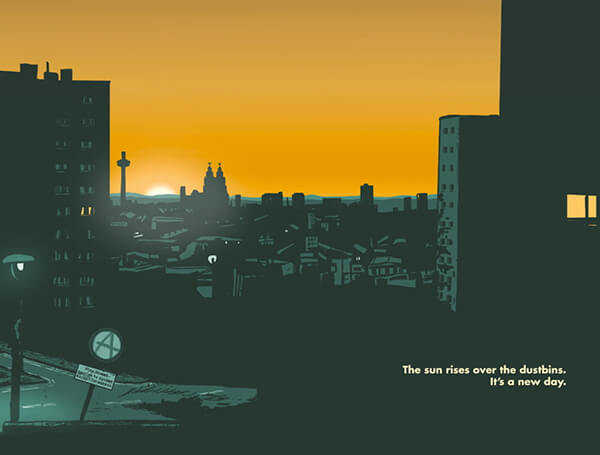
Anfield Road (Chris Shepherd/Titan Publishing)
With the popularity of the book and your history of creating outstanding films, do you think an adaption could be on the horizon?
Yes there could be a film of Anfield Road, for sure. But I’m not really thinking about that at the minute; I’m currently plotting out a sequel to the book.
And do you think we’ll see more of Conor’s journey, or will you leave us hoping for the best for him and his future?
Yeah, I’ve been thinking about what happens next to Conor in the story, as well as all the other characters including Maureen and Danny. I don’t want to give away too much if you haven’t read the book yet. The sequel is set in London, in the 1990s.
What I did with Anfield Road was capture many parts of Liverpool that no longer exist, as they have been demolished. I want to do the same for London. I want to recreate 90s London, particularly focusing on places that have long gone or been forgotten. It’s funny, I’ve actually lived in London longer than I ever lived in Liverpool, so it’s time for me to explore the capital.
London is so big and changes so rapidly that you can hardly remember what used to be there. Parts of London have just disappeared. So it would be fun to recreate some of these. I have a few ideas in mind, such as incorporating settings like the Black Cap in Camden or the wonderful Piccadilly Café on Denman Street. These were really pivotal places for many of us.
So, there’s a lot to look forward to in the future.
Chris Shepherd will present Anfield Road at the Encounters Film Festival this week (Sep 25, 2:30pm Arnolfini). See below or visit https://anfieldroadstory.com/blog for a full list of upcoming tour dates.